
A wave of corporatization is hitting the veterinary industry, but does a one-size-fits-all approach work?
Updated on
Veterinarian John Robb steers his Chrysler out of the parking lot, gliding past the Dunkin’ Donuts and the boarded-up furniture store, and leaves behind another Saturday shift at Catzablanca, the clinic where he’s been reduced to working since losing his own hospital. There’s a big cardboard box stuffed with court papers in the back seat, the air conditioning is up against Connecticut’s July heat, and an audiobook of the Bible is playing loud. “When I get into the car,” Robb tells me, “I’m like, ‘Lord I need to hear from you.’ ”
It wasn’t a day harder than most, but he’d had to put a little girl’s cat to sleep while she sobbed in the reception area. Later, exam rooms got backed up while Robb investigated why another feline was vomiting. A cell phone picture of a flowerpot knocked over in the owner’s backyard suggested the cause: poisonous hydrangea blossoms. By the time Robb locked up for the night, the cat was resting in a cage, hooked up to an IV and meowing.
“I’ve probably listened to the Bible 500 times in the last eight years,” he says as we pull onto the highway, leaving the Hartford suburb of Rockville. “That’s when God decided to give me jobs at least an hour away from home.”
Eight years ago is also when he made what he thought of even then as a deal with the devil. Robb is a born-again Christian who believes he’s been called to protect pets, because, he says, they can’t speak for themselves. But concern for animals wasn’t foremost in his mind in 2008, when he decided to buy a franchise of Banfield Pet Hospital, America’s biggest chain of veterinary clinics. He was thinking about money.
Many veterinarians scoffed that Banfield dumbed down its medicine by using a software program, PetWare, to standardize care. The company also put its hospitals inside the big-box retail stores of PetSmart, turning medical care into a product to be purchased along with dog food and chew toys—just another item on a one-stop shopping list. A former chief medical officer at Banfield once compared the business to the no-frills carrier Southwest Airlines. “If you want first class,” he said, “you can buy it from a different airline.” Some animal doctors called Banfield “vet in a box,” but it was a gibe that betrayed anxiety. Veterinarians feared Banfield just as mom and pop grocery stores once feared Walmart.
Robb knew all of this. He also knew that a lot of doctors thought Banfield overvaccinated pets. But he had a wife and two kids to support, and he knew he could make a very good living with a pet hospital inside a shopping center.
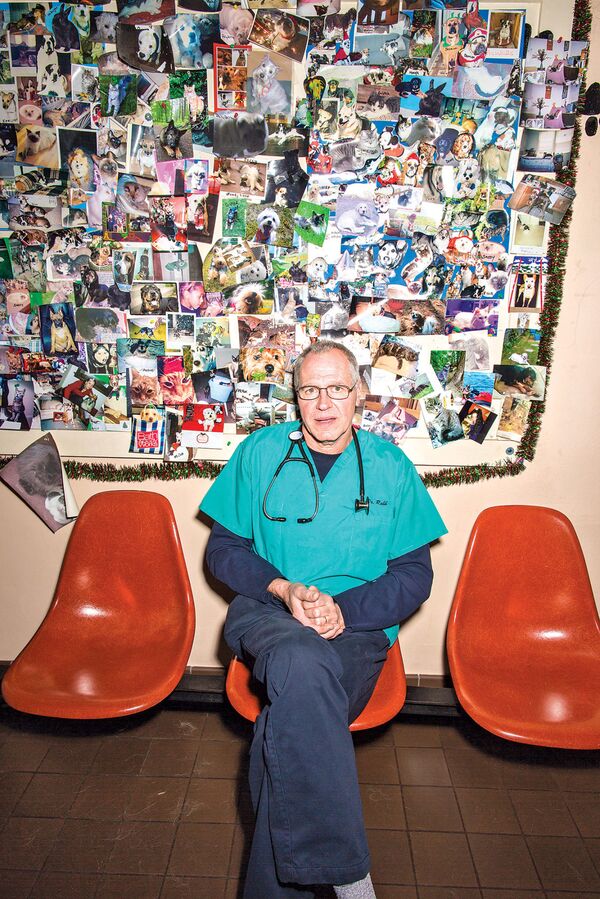
Robb at a New Haven clinic.
Photographer: Simone Lueck for Bloomberg Businessweek
A 57-year-old with thinning hair, Robb walks with a slight limp, the result of a high school football injury. He’s an excitable man, a freight train of a talker. Near midnight, he’s pacing in his New Fairfield farmhouse, still in the green surgical scrubs he wore to work, having talked nonstop from the minute we left Catzablanca. If his wife, Aldona, hadn’t touched him on the shoulder to remind him of the time, he might have ranted until morning about how Banfield stole his hospital and is turning animal medicine into an exploitative, even dangerous business. “It’s peticide,” Robb says, pausing before offering a definition. “The systematic destruction of pets by corporations for profit.”
Pet care is undergoing the same sort of consolidation that transformed human health care in the 1990s, and Robb has worked for both of the industry’s biggest players. In 1999 he sold his first practice for $1 million to VCA—then called Veterinary Centers of America—a consolidator that’s bought hundreds of animal hospitals and trades on the Nasdaq exchange under the ticker WOOF. He worked six years for VCA. Then, in 2008, he paid $400,000 for his Banfield franchise in prosperous Stamford. Banfield had itself traded hands just a few months before, when the veterinarian who founded the company sold it to Mars, the giant candy and pet-food manufacturer. The change had dire consequences for Robb and, he says, for millions of pets.
In December 2012, Banfield seized Robb’s franchise for violating its vaccine protocols and breaking Connecticut law. Robb doesn’t dispute that he started giving half-doses to little dogs after several almost died of vaccine reactions, but he says Banfield used that as an excuse to take his hospital—just as it came up with pretexts for taking hospitals from other veterinarians. Banfield sued Robb over his medical practices. Robb countersued, claiming breach of contract, and has turned his case, still playing out in court, into a crusade against Banfield, which he says pushes vets to put profit ahead of the health and safety of animals.
Banfield says its medicine is compassionate and sound. In a letter responding to this story and Robb’s accusations, the company writes: “We strive to understand the needs of pets and clients and provide safe, high-quality care to every pet, every time.” It’s Robb’s practices, Banfield says, that demand scrutiny.
The fight has gotten messy. Robb has picketed and been arrested. Once he was handcuffed to a stretcher in the aisles of PetSmart and carried to a psych ward; lawyers for Banfield and PetSmart accused him of “walking around the store in an erratic manner with Bible in hand.” Later, after failing to have the case thrown out, they tried another tactic: accusing Robb of witness tampering. The judge rejected that. Robb has made outrageous moves of his own. He turned down a 2013 settlement offer by asking for $20 million, triple what even he thinks he’s owed. If that wasn’t folly enough, Robb demanded that Banfield be renamed Protect the Pets and that he be made chief medical officer.
Now, as he waits for a trial, Robb seeks justice by social media. His “Boycott Banfield” page on Facebook draws a steady stream of bereaved pet owners and former Banfield doctors and nurses, few of whom seem to care or even know about Robb’s religious views or his commercial dispute. They’ve simply come to rage about Banfield and the corporatization of pet care.
When Robb was growing up in the 1960s in Long Branch, N.J., most of his neighbors kept their dogs chained up in the backyard. On the rare occasions when people took their pets to a veterinarian, it was for the basics: to have them spayed or neutered or put down.
By 1985, when Robb finished veterinary school at the University of California at Davis, animal medicine was changing. More technology came into play as hospitals started selling their old MRI machines and CAT scanners to veterinary clinics. And, as human birthrates fell, pets took the place of children in some families. In 2014 there were 179 million cats and dogs in the U.S., up from 98 million in 1980. Today, according to the American Animal Hospital Association (AAHA), more than 80 percent of pet owners think of themselves as their pets’ moms and dads. Americans love their pets so much, they spent $35 billion on veterinary care in 2015.
This outpouring of sentiment and money represents an amazing opportunity for businesses such as Banfield and VCA. Tom Fuller, VCA’s chief financial officer, has started investor presentations with a story about a man who drowns in a frozen lake trying to rescue his dog from a hole in the ice. “It’s horrible,” he says. It’s also one big reason, he continues, investors should love the pet-care industry. “We’re all kind of crazy about our pets. It’s why the business is so resilient.”
It’s not the only reason, though. In contrast to human medicine, in which everything from the nurse-patient ratio to the caloric count of injections is mandated and overseen by a web of government agencies, veterinary medicine is largely unregulated. And pet owners pay cash: Vets don’t deal with insurers haggling for better prices or questioning whether that vaccine or ultrasound or blood panel is really necessary. (A small percentage of pet owners carry insurance, but they pay vets upfront, like anyone else, and then take on their insurers for reimbursement.) What’s more, when veterinarians make fatal mistakes, they face no real financial consequences. The law hasn’t changed to reflect the attitudes of the average pet owner; courts still treat pets as property. Damages paid to owners whose pets have been killed or injured are so low that a typical medical malpractice insurance policy for a veterinarian costs less than $20 a month. Damages are so low, in fact, that few pet owners can find a lawyer willing to take even the most egregious case of veterinary malpractice.
When Bobby Hanners’s shar-pei, Charlie, died at a Banfield hospital in Hagerstown, Md., during a neutering in 2015, the company offered to do little more than pay for the dog’s disposal. “It was like, ‘Yeah, we lost his dog. We took care of his cremation, that’s enough,’ ” says Hanners, a manager at a Hagerstown McDonald’s and one of the pet owners who posted on Robb’s Facebook page.
Asked about the accident, Banfield responded, “There was no evidence of intent to harm or malice—this was a situation when a doctor was performing in a manner they believed was best for the pet.”
Hanners says Banfield’s veterinarian used the wrong sedatives and then tried to cover up the error. Even so, no lawyer would have taken the case if a Banfield employee hadn’t violated privacy laws by posting details of Hanners’s billing history on Facebook in an attempt to paint him as someone looking to exploit his pet’s death for money. “Quit looking for a check,” the employee wrote. Hanners sued for invasion of privacy and settled with Banfield.
“There would have been nothing, absolutely nothing that I could have done, and that was straight from my lawyer’s mouth,” he says. “They would have got away with it.”
West Los Angeles Animal Hospital may be the apotheosis of corporate veterinary care. When it became VCA’s first purchase, in 1986, it was already the biggest pet hospital west of the Mississippi River. Today it occupies a three-story building with an attached parking garage and is staffed by 60 doctors, including cardiologists, neurologists, oncologists, even a psychologist. There are underwater treadmills for overweight cats and gimpy dogs and a sterile isolation room for pets recovering from bone marrow transplants, a cancer treatment that can easily cost $16,000. “All the advancements that you hear about in veterinary medicine? None of that would be possible if it was just your neighbor working by himself like it used to be,” says VCA Chief Executive Officer Bob Antin.

No comments:
Post a Comment